Wolfgang Pauli
“To us, the only acceptable point of view appears to be the one that recognizes both sides of reality, the quantitative and the qualitative, the physical and the psychical, as compatable with each other and can embrace them simultaneously.” —Wolgang Pauli

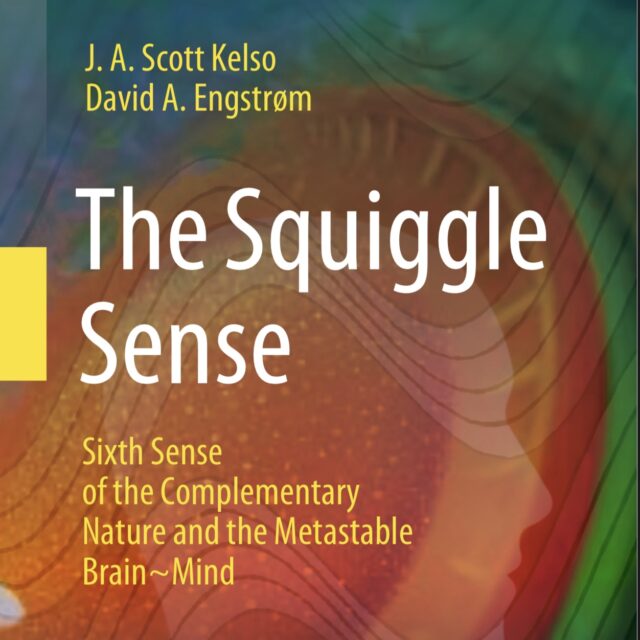
The Complementary Nature
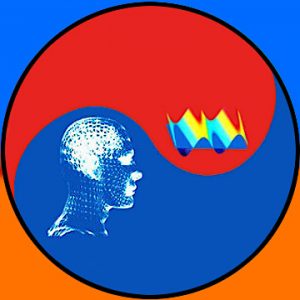
The Complementary Nature, proposes contend ubiquitous contraries are complementary and introduces a comprehensive, empirically based scientific theory of how the polarized world and the world in between can be reconciled. They nominate the tilde, or squiggle (~), as the symbolic punctuation for reconciled complementary pairs. Experiments show that the human brain is capable of displaying two apparently contradictory, mutually exclusive behaviors at the same time. Coordination dynamics—a mathematically expressed theory that reconciles the scientific language of “states” with the novel dynamical language of “tendencies”—attests to the complementary nature inherent in human brains and behavior. It may explain, Kelso and Engstrøm argue, why we (and nature) appear to partition things, events, and ideas into pairs. Kelso and Engstrøm’s account is not just metaphorical; the reconciliations they describe are grounded in the principles and mathematical language of the theory of coordination dynamics. The Complementary Nature provides a clear-cut methodology for this evolving theory of brain and behavior that can also be applied to areas and developments outside the neurosciences, hence aiding reconciliations within and between disparate fields.”

Seamus Heaney
“Strange how things in the offing, once they’re sensed, Convert to things foreknown; And how what’s come upon is manifest Only in light of what has been gone through. Seventh heaven may be
The whole truth of a sixth sense come to pass.” —Seamus Heaney

Samuel Beckett
“The search for the means to put an end to things, an end to speech, is what enables discourse to continue. The danger is in the neatness of identifications.” —S. Beckett

Neils Bohr
“If you hold opposites together in your mind, you will suspend your normal thinking and allow intelligence beyond rational thought to create a new form.”—Niels Bohr

Isaac Newton
“The beatles power of life and will by which animals move their bodies with great and lasting force demonstrate that there has to be other undiscovered laws of motion.” —Sir Isaac Newton

Howard H. Pattee
“I do not see any way to avoid the problem of coordination and still understand the physical basis of life.” —Howard H. Pattee

Frank Wilczek
“The world is simple and complex, logical and weird, lawful and chaotic. Fundamental understanding does not resolve these dualities. Indeed it highlights and deepens them. You can’t do justice to physical reality without taking complementarity to heart.” —Frank Wilczek

Dynamic Patterns
Forward by Hermann Haken: “For the past twenty years Scott Kelso’s research has focused on extending the physical concepts of self-organization and the mathematical tools of nonlinear dynamics to understand how human beings (and human brains) perceive, intend, learn, control, and coordinate complex behaviors.
In this book, Kelso proposes a new, general framework within which to connect brain, mind, and behavior. Kelso’s prescription for mental life breaks dramatically with the classical computationall approach that is still the operative framework for many newer psychological and neurophysiological studies. His core thesis is that the creation and evolution of patterned behavior at all levels—from neurons to mind—is governed by the generic processes of self-organization.
Both human brain and behavior are shown to exhibit features of pattern-forming dynamical systems, including multistability, abrupt phase transitions, crises, and intermittency. Dynamic Patterns brings together different aspects of this approach to the study of human behavior, using simple experimental examples and illustrations to convey essential concepts, strategies, and methods, with a minimum of mathematics.” Kelso begins with a general account of dynamic pattern formation. He then takes up behavior, focusing initially on identifying pattern-forming instabilities in human sensorimotor coordination. Moving back and forth between theory and experiment, he establishes the notion that the same pattern-forming mechanisms apply regardless of the component parts involved (parts of the body, parts of the nervous system, parts of society) and the medium through which the parts are coupled. Finally, employing the latest techniques to observe spatiotemporal patterns of brain activity, Kelso shows that the human brain is fundamentally a pattern forming dynamical system, poised on the brink of instability. Self-organization thus underlies the cooperative action of neurons that produces human behavior in all its forms.”

Coordination Dynamics
“Coordination represents one of the most striking, most taken for granted, but least understood features of living things. Recently a new foundation for understanding coordination has emerged called Coordination Dynamics. This book brings together scientists from all over the world who have defined and developed the field of Coordination Dynamics. Grounded in the concepts of self-organization and the tools of nonlinear dynamics, appropriately extended to handle informational aspects of living things, Coordination Dynamics aims to understand the coordinated functioning of a variety of different systems at multiple levels of description. The book addresses the themes of Coordination Dynamics and Dynamic Patterns in the context of the following topics: Coordination of Brain and Behavior, Perception-Action Coupling, Control, Posture, Learning, Intention, Attention, and Cognition.”

Benoit Mandelbrot
“Clouds are not spheres, mountains are not cones, coastlines are not circles, and bark is not smooth. Nor does lightning travel in a straight line.” —Benoit Mandelbrot